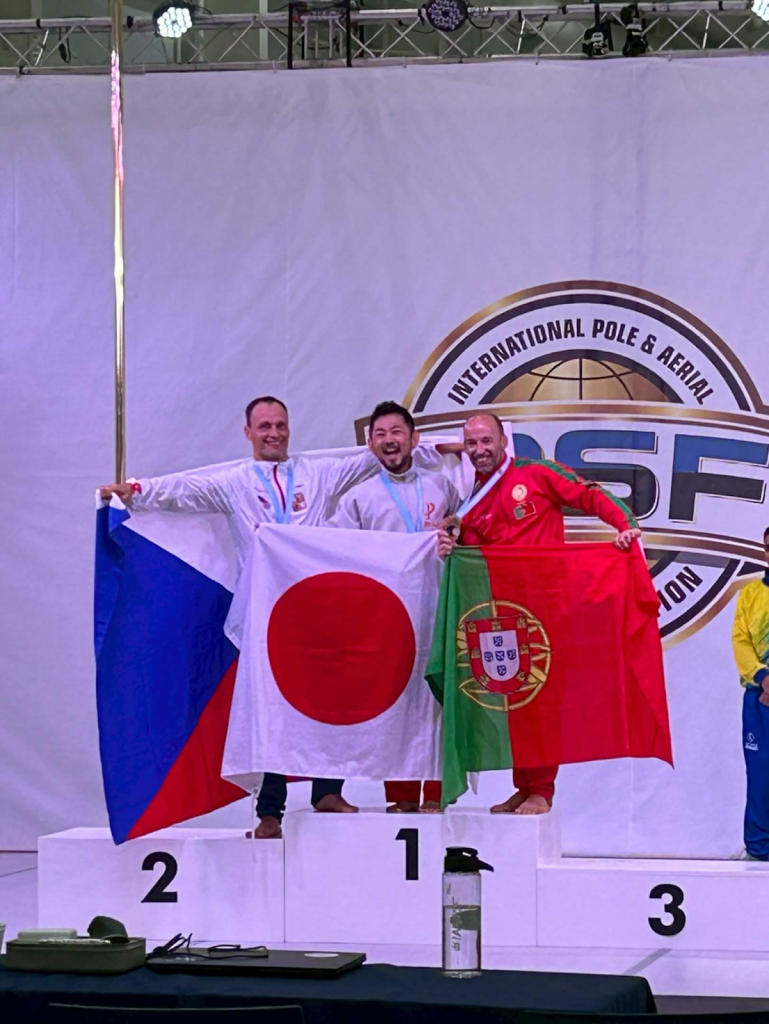
From the 20th to the 25th of October 2025, the International Pole and Aerial Sports Federation (IPSF) held its World Pole & Aerial Championship in Argentina. Among the results of their many events, one stands out: the 40+ Men’s division, won by a Japanese competitor who just also happens to be a trans man.
Michael, the nom de guerre he is commonly known by in and around Tokyo, currently works as a Thai massage therapist, but finds time in his schedule to pursue a career as a pole sports athlete.
The following is an email interview done with Michael and WhatTheTrans on his sporting history as well as his participation in the championship.
WhatTheTrans What kind of sports have you been involved with?
Michael Before pole dancing I didn’t do anything sports-related, so my whole history with sports is my pole dancing career. So, about 13 years.
WTT What got you started with it?
M It was to start exercising. Before I started pole dancing, I tried going to a gym for a while, but I hadn’t transitioned yet. At the desk for the gym, they gave women a pink locker room key, and a blue one to men, but I had already started HRT, so my voice and appearance were already masculinizing, so every time I went to the desk, they tried to give me a blue key. I had to keep saying, “Excuse me, I’m a woman”. That was tiring, and using the women’s locker room became painful, so I quit soon after. Before long, I started to feel like I needed to exercise, so I looked on the internet for something that looked interesting. That’s when I found a pole dance studio. I had never really looked into it before, so I only had a pretty pedestrian understanding of it. The website for the studio showed that they had male instructors, so I thought, “Hey, men can do this, too.” They didn’t require a registration fee, and one lesson was only 3000 yen (about 15 GBP). You can just go in and sign up, so I figured, why not?
WTT For people who aren’t familiar, could you describe what pole dancing involves?
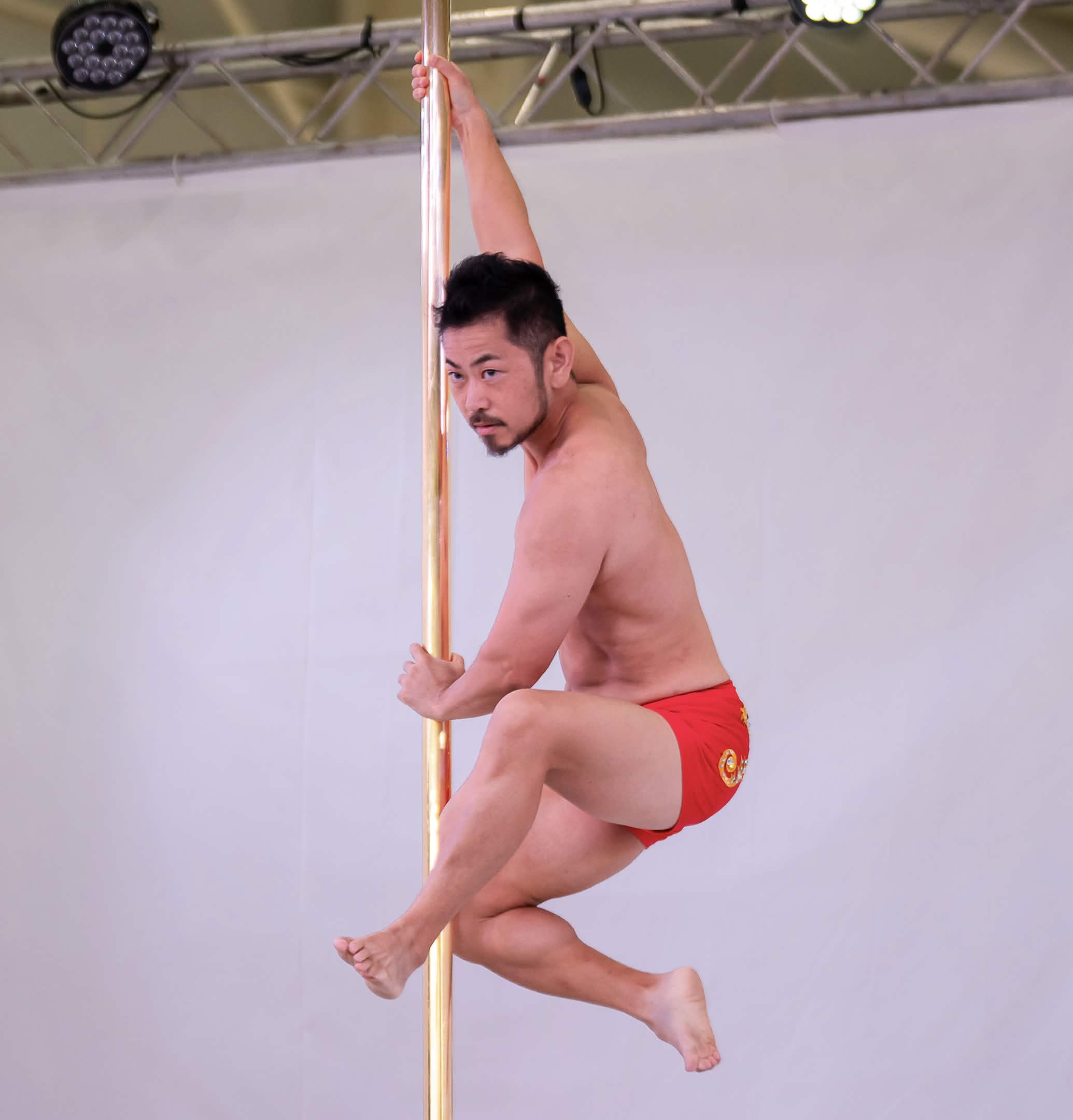
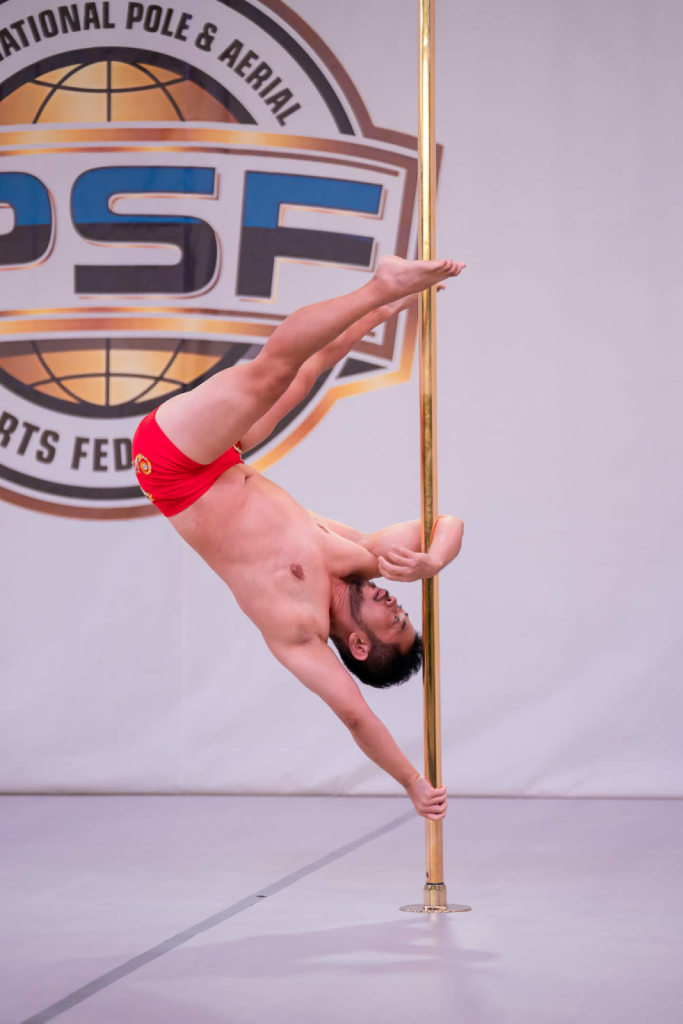
M Pole dancing uses a vertical steel pole that stands perpendicular to the ground. You climb up and swing around it, performing different skills or dancing to music. To climb the pole, you need to use the friction between the pole and your skin, so you end up having to expose a lot of it. That’s where people tend to see it as some sort of sexy thing. The pole can either be a spinning pole, where the pole itself turns, or a static pole, which doesn’t. There are a lot of different means of expression as well, such as wearing heels or boots, doing sexy floor moves, adding a story to an artistic performance… There are competitions that focus on flexibility, strength, difficulty, and completeness as well.
WTT How popular is it in Japan? Is it well known there?
M I’m not exactly sure, but compared to when I started, it seems like it’s gained a lot of popularity. Before, it seemed like studios you could learn at were limited to the big cities, but now there are some in less populated areas. It was also seen as a mainly women’s activity, but more men are participating now, and there are even programs for kids at different studios. Japan also started hosting competitions. Even so, when I talk to people about it for the first time at work or in private, most say, “Wow, I’ve never seen that, what’s it like?” So, it seems like not many have an opportunity to see it.
WTT I heard you came out as trans after starting pole dance. Did you feel supported by your friends and the pole dancing community? What kind of a reaction did you receive?
M When I started, I didn’t really feel any need to come out, so I didn’t say anything. However, when I started learning over ten years ago, almost everyone else was a woman, and when a man showed up, they were usually gay. So, when talking with people I became friendly with, I began to get the feeling that they saw me as a cis gay man, so I told them, “No, I’m not gay, I’m a trans man.” When I did, they said “What? You’re not gay? You’re trans? Wow…” When I started coming out, it felt like for a lot of people that maybe they understood, or maybe I was telling them something beyond their grasp. For me, it doesn’t matter if someone’s gay or trans or whatever, we’re there to enjoy dancing. It seems to me that a lot of people are looking at the person, not at their sexual orientation or gender identity. When my friends from pole dancing and I go out to eat, we usually just talk about pole dancing. We encourage people who are working on improving, and think about how we can improve ourselves as well. For me, it feels like we can just ignore things like our gender, nationality, the color of our skin, differences in language, what we do at work, etc.
WTT So you decided to enter a competition for the first time after having already learned pole dance for 10 years. What brought you to that decision?
M Studios have recitals once or twice a year. It’s an opportunity to demonstrate what you’ve been working on. I had participated in them and enjoyed it, and I occasionally got invites to perform at clubs and events in Tokyo. I’m not personally all that good at expressing myself for entertainment, so I thought about how to change things. There are a lot of different kinds of competitions, but the one I thought was the most suited to me was pole sports competitions. I started without too much forethought, but the rulebook was all in english, and there was a lot of paperwork to submit, so I realized in short order that I’d signed up for something that’s actually pretty involved.
WTT Usage of testosterone often becomes a problem for trans men when they seek to participate in competitive sports, but how about in pole dancing? Were there any specific rules the governing bodies had in place? What did you do to clarify or negotiate with them?
M I don’t think all pole sports competitions have doping tests. However, I believe the one I participated in wants to be ready to become an Olympic event, so they’re strict about doping. Everyone who participates has to receive anti doping education. I didn’t even know they were doing testing (They don’t test everyone, only people at random on the day of competition). My coach contacted the competition organizers ahead of time just to be safe. We didn’t get an answer. So, we asked a competition judge (a Japanese person I’m friends with) to contact them as well. We got an e-mail saying “We will take this up at our next board meeting”, but then nothing. We kept contacting them, but got nothing.
So, we explained the situation to the representatives at the Japanese branch of the organization and showed them a letter of diagnosis from a doctor (explaining that I had transitioned and spent the last 20+ years living as a man, as well as regularly receiving testosterone injections). They gave me permission to participate in the competition in Japan in 2024. Pole sports competitions are divided into men’s and women’s categories as well as by age. They also have amateur and elite divisions. The differences between the amateur and elite divisions are things like different points for different moves, but no matter how good your showing is in the amateur division, you can’t earn a spot at the world championship. Since it was my first competition, I entered in the amateur division, but I ended up winning. Competitions are hard, but the feeling of accomplishment and the joy of it led me to want to try the elite division in the next one in 2025. I wasn’t looking to win, I was just enjoying putting my all into practicing and having my effort recognized. So, in the 2025 Japan championship’s 40+ men’s elite division, I got second place. If you get first place, you’re guaranteed a spot in the world championship, but according to the rules, if you place second but earn over a certain number of points, you also get a spot. I was able to do that, so I earned a place in the world championship. The championship organizers said nothing against it, so I entered in the men’s category for the 2025 championship in Argentina, and won in the 40+ men’s division.
WTT What are your plans for pole dancing from here on?
M I’m going to keep on participating in events and entering this year’s pole sports championship.
WTT Do you have a message for anyone interested in participating in sports competitions?M I want people to honor their desire to participate in sports, and if they’re hesitant because they’re nervous about their gender or something, they should try to talk with someone, anyone, about it. Even if you can’t find a solution right away, you might be able to find a solution eventually, and they might be able to introduce you to someone else who can help. It’s really a loss to miss out on that desire and that chance to participate just because of that. Participating can show you a new world, introduce you to new people, and lead you to new things. Experience is a treasure.